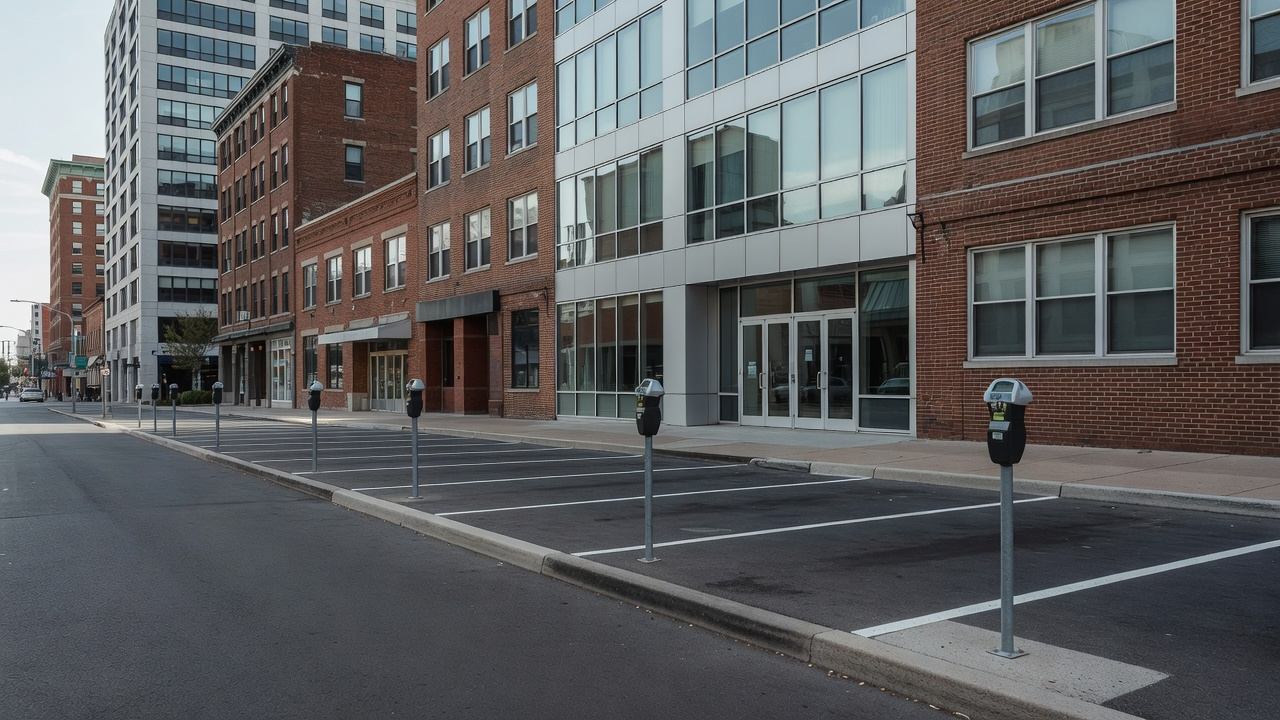
An August 14, 2026 memorandum from Dallas Assistant City Manager Dev Rastogi to the Mayor and City Council documents a rate adjustment made not by ordinance but under standing policy. Per the city’s On-Street Parking and Curb Management Policy, the stated goal is to maintain average paid occupancy between 65% and 70% “to support reasonable parking availability, reduce congestion, and ensure curb access for residents, visitors, and deliveries.” Rates are evaluated periodically based on average utilization during operational hours.
The occupancy target is not novel — performance-based parking pricing has been policy in several large US cities for over a decade. What is worth studying is the administrative machinery: a documented band, a periodic measurement, and a rate change implemented by memorandum rather than by a council vote each time.
What the memo actually changes
Two corridors, phased.
Main Street Corridor, effective September 1, 2026. Every listed area rose by exactly $0.25: 1100 Patterson, 900 Main St, and 2200 Elm St from $1.00 to $1.25; 900 San Jacinto from $1.20 to $1.45; all remaining meters from $1.50 to $1.75. Each is annotated with a measured occupancy of “High Demand.”
Deep Ellum, effective October 15, 2026. All meters from $1.00 to $1.25, same $0.25 increment.
Alongside the rates, both corridors move to uniform paid hours of 7:00 a.m. to midnight on those same dates, and all paid parking areas citywide transition to those uniform hours beginning September 1 and completing by December 15, 2026.
Why the governance structure is the transferable part
Most cities set meter rates through a council action tied to a budget cycle. That produces two predictable pathologies: rates stay frozen for years because reopening them is politically costly, and when they finally move they move a lot, which generates the backlash that discourages the next adjustment.
Delegating rate adjustment to a documented policy with a numeric target changes the character of the decision. The question in front of staff is no longer “should parking cost more” but “is measured occupancy inside the band.” That is a question with an empirical answer, and it can be revisited frequently in small increments rather than rarely in large ones.
The three components a city would need to replicate are all visible in the memo: an adopted policy that states the target band and delegates adjustment authority, a periodic measurement of average paid occupancy during operational hours, and a written notification to the legislative body when an adjustment is made. That last item is what keeps the delegation accountable — the council does not vote on each change, but it receives a record of each change and the measurement behind it.
The uniform-hours change is a quieter piece of the same logic. A patchwork of enforcement windows across a downtown is a compliance problem, because a driver cannot reasonably know which block ends at 6 p.m. and which runs later. Standardising on a single window makes the rules legible, which matters more for compliance than the rate does.
Where the first round invites scrutiny
A framework is tested by whether it produces differentiated outputs, and this round did not.
Every adjustment in the memo is an increase, every increase is exactly $0.25, and every listed area is annotated “High Demand.” There is no area where measured occupancy fell below the band and the rate came down, and no area where the increment differed because the gap from the target differed.
There are innocent explanations. The corridors selected for this round may genuinely all be above the band. A uniform increment is administratively simple and easy to communicate. A first phase may deliberately be conservative.
But a genuinely occupancy-responsive system should eventually produce decreases, and the credibility of the framework depends on it doing so. If rates only ever move up, the occupancy target functions as a justification for revenue increases rather than as a control mechanism, and the public will read it that way regardless of the policy language. Cities adopting this model should commit in advance to publishing the measured occupancy alongside the rate — including for areas where the measurement does not support a change — and should expect to lower a rate somewhere in the first few cycles or explain why not.
The memo’s occupancy column also reports a category, “High Demand,” rather than a number. A framework whose stated target is a numeric band between 65% and 70% but whose published evidence is a qualitative label is not yet fully auditable. Publishing the measured percentage per area is a small change that would make the whole structure verifiable.
The notification gap
The memo states that the Department of Transportation and Public Works will share the updates through social media channels and coordinate with impacted City Council offices.
For a change that alters what a driver pays and extends paid hours to midnight, social media plus council coordination is thin. The population most affected by an extension of paid hours into the evening — people parking downtown for dinner, shift workers, residents of blocks without off-street parking — is not reliably reached by a municipal department’s social channels.
This is the most copyable weakness in the model, and the easiest to fix. On-meter signage announcing a pending change, a notice period before the effective date, and a published dataset of current rates by block are all low-cost and materially improve whether the change is experienced as a policy or as a surprise.
What to watch
The useful evaluation of this framework is not whether occupancy fell into the band on Main Street by year end. It is whether the second and third rounds look different from the first — whether increments vary with the size of the gap, whether any rate is reduced, and whether the published evidence moves from a demand label to a measured percentage.
If those things happen, Dallas will have a genuinely portable model: a small, frequent, evidence-linked adjustment process that avoids the freeze-then-shock cycle. If every round is a uniform quarter increase annotated “High Demand,” the occupancy band is documentation rather than governance, and other cities should copy the delegation structure while building a stricter evidentiary requirement into it.