For most of the last decade, cities regulated shared e-bikes and e-scooters through permit conditions rather than code. That was a reasonable expedient: permits could be rewritten annually, the industry was volatile, and nobody wanted to amend an ordinance for a business model that might not exist in eighteen months. The industry stabilized. The permits did not become code. And the result is a growing mismatch between how these vehicles are actually parked and what municipal code says about parking.
That gap is now closing, unevenly. The drafting problems cities are hitting are consistent enough to be worth cataloguing before your agency writes its version.
What the permit era got right, and what it cannot do
Permit conditions remain the workhorse. Seattle’s free-floating shared micromobility permit requirements illustrate the mature form: shared devices may be parked in the sidewalk furniture zone — the strip between the pedestrian through-zone and the curb, where signs, trees and street furniture already live — or at any city bike rack. Devices may not block driveways, crosswalks, loading zones, accessible parking spaces, bus stops, or corners. The city may designate no-parking zones, which the operator is required to implement through geofencing, and operators must relocate non-compliant devices within a specified time.
That structure works because it binds a named counterparty. The operator holds the permit, the permit carries obligations, and non-compliance has a consequence the city can actually apply. Most policies addressing rentable devices follow this shape: specify that devices be upright and not obstructing flow, and give the vendor a clock to fix violations.
What a permit cannot reach is the privately-owned device. As personally-owned e-bikes and e-scooters have grown to dominate the fleet in many cities, the regulatory instrument covers a shrinking share of the vehicles. There is no operator to fine and no geofence to enforce. That is the specific gap driving the shift to code — and it is why copying permit language into an ordinance does not work, because permit language assumes a party that code cannot presume.
Where the drafting goes wrong
Four recurring problems, drawn from how jurisdictions have actually approached this:
Defining the vehicle by its motor instead of its footprint. Municipal e-bike provisions overwhelmingly organize around the three-class system — speed capability, throttle versus pedal assist — because that framework was inherited from state vehicle codes governing where devices may ride. For parking, class is nearly irrelevant. What determines whether a device fits in a furniture zone is its dimensions, weight, and whether it stands unaided. A cargo e-bike and a Class 1 commuter bike are the same class of problem for riding rules and entirely different problems for parking. Codes that inherit the class taxonomy end up unable to say the thing they need to say.
Regulating by prohibition without designating capacity. It is straightforward to list where a device may not be parked. It is much harder, and much more consequential, to say where it may. A code that prohibits sidewalk obstruction without designating adequate parking capacity has not solved a problem; it has criminalized an unavoidable behaviour. Fort Collins staff have been working toward a council ordinance in 2026, and the sequencing question — capacity before prohibition — is the one that determines whether such rules produce compliance or just citations.
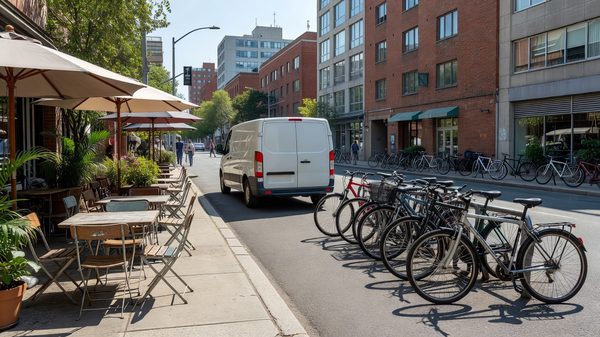
Treating the sidewalk as the default location. The furniture-zone approach is sound where a furniture zone exists. On older, narrow frontages it does not, and the code silently pushes devices into the pedestrian through-zone or the building line. Accessibility complaints follow, and they are the most legally exposed category of curb complaint a city faces. Where the sidewalk cannot absorb the demand, the answer is on-street: converting a parking space to a corral holds roughly ten to twelve devices in space that previously held one car, and it moves the conflict off the pedestrian realm entirely.
Writing rules with no inventory of where devices actually accumulate. Micromobility parking demand is highly concentrated — transit entrances, campus edges, retail nodes, event venues. A uniform citywide rule spreads regulatory effort evenly across a problem that is not evenly distributed. Trip-end data, which shared operators already report under most permit frameworks, identifies the twenty locations that generate most complaints. Those locations need designated capacity; most of the city needs very little.
The enforcement question nobody enjoys
Enforcing parking rules against personally-owned micromobility is genuinely difficult, and cities should be honest with themselves about the tools available. There is no registration, so there is no owner to cite in most jurisdictions. Impoundment of a personal vehicle is a heavy remedy for a parking violation and creates storage and due-process obligations agencies rarely want.
Which points at the pragmatic conclusion: for privately-owned devices, code should function primarily by making compliance easy rather than by punishing non-compliance. Designated corrals at the demand concentrations, clear and consistent signage, and enough capacity that the compliant option is also the convenient one will move behaviour further than a citation regime the agency cannot staff. Reserve enforcement for the genuinely hazardous cases — blocked accessible parking, blocked crosswalks, blocked bus stops — where the harm justifies the effort and the legal basis is strongest.
For shared fleets, keep the permit. It works, it binds an accountable operator, and geofencing plus relocation clocks give the city leverage that code does not.
A drafting sequence that holds up
- Define by physical footprint, not motor class — dimensions, weight, and self-standing capability determine where a device fits.
- Map demand before writing prohibitions, using operator trip-end data to find the concentrations.
- Designate capacity at those points first, preferring on-street corrals wherever the sidewalk furniture zone is inadequate.
- Then prohibit, narrowly, in the categories with clear safety and accessibility stakes.
- Keep shared-fleet obligations in the permit, where an operator can be held to a relocation clock and a geofence.
The cities that have struggled with this mostly inverted steps two and four — prohibiting first, mapping later, and discovering that the rule was unenforceable because the compliant alternative did not exist. The curb has new users. Registering them in code means giving them somewhere to go before telling them where they cannot.
Frequently Asked Questions
Where are shared e-bikes and e-scooters typically allowed to park?
Common practice is the sidewalk furniture zone — the strip between the pedestrian through-zone and the curb — or at existing bike racks, with prohibitions on blocking driveways, crosswalks, loading zones, accessible parking, bus stops and corners.
How do cities enforce parking rules for shared devices?
Through permit conditions: cities may designate no-parking zones that operators implement via geofencing, and operators are typically required to relocate non-compliant devices within a set time period.
Why can’t permit rules cover privately-owned e-bikes?
Permits bind the operator. A personally-owned device has no permit holder, no geofence and usually no registration, so the obligations and remedies in a shared-fleet permit have nobody to attach to.
Should e-bike parking rules use the three-class system?
For parking, generally no. The class framework describes speed and propulsion, which governs where a device may ride. Parking suitability depends on footprint, weight and whether the device stands unaided.
What is the most effective single intervention?
Designated on-street corrals at the handful of locations that generate most of the demand. Converting one car space yields room for roughly ten to twelve devices and moves the conflict off the pedestrian realm.