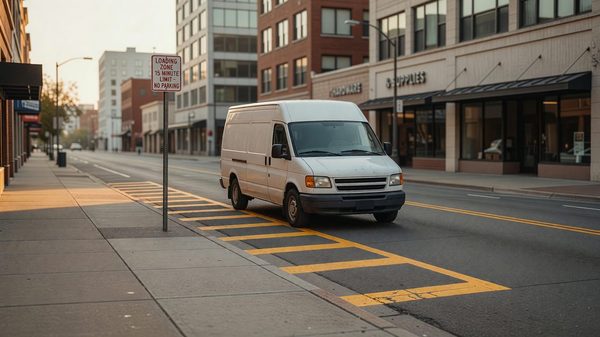
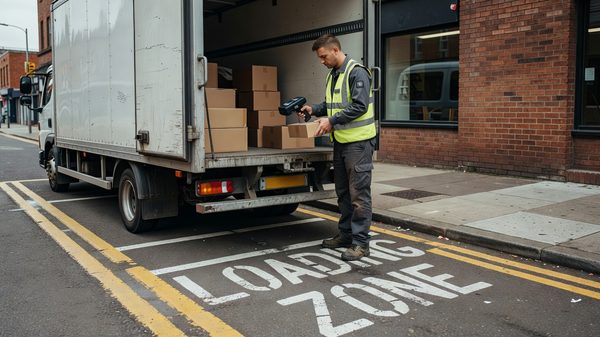
On April 8, 2026, New York City announced an Office of Curb Management inside its Department of Transportation. The substance of the announcement — vehicle turnover, roadway outdoor dining, a pilot for on-street waste containerization — is unremarkable enough that most peer agencies could have written the same list. What is genuinely new is the org chart.
Until now, curb decisions in New York were distributed across agencies and divisions: parking regulations in one place, loading zones in another, outdoor dining in a third, waste collection in a fourth, bike parking somewhere else again. The new office centralizes curb planning that was previously scattered across multiple city agencies covering all five boroughs. For planners in other cities, that consolidation is the transferable part. The policy items are local; the structural problem is universal.
The scale that forces the question
The numbers explain why New York arrived here first. The office is responsible for policy across roughly 6,300 miles of streets and approximately 3 million curbside parking spaces. City officials have been blunt that some curb regulations date to the 1950s — which is to say they were written for a street where the competing uses were private cars and the occasional delivery truck, not app-dispatched couriers, dining platforms, dockless scooters, EV charging, and containerized waste.
The stated early objectives are narrow and testable, which is a good sign in a new office: increase vehicle turnover at the curb, permit roadway outdoor dining, and pilot on-street waste containerization. Its broader remit covers multimodal transportation, loading zones, microhubs, pick-up and drop-off zones, and secure bike parking. Leadership had not been named at announcement.
Why the fragmentation problem is the real subject
Any agency that has tried to reallocate a block face knows the failure mode. A single 200-foot stretch of curb might be governed by a parking regulation set by one division, a commercial loading rule administered by another, a sidewalk-café permit from a third body, a bike-corral installation queue in a fourth, and a sanitation collection schedule nobody consulted. Each of those decisions is individually defensible. Collectively they produce a curb that serves no use particularly well and cannot be changed without convening five stakeholders who do not report to each other.
This is the coordination cost that a dedicated office is meant to eliminate, and it is why the move is more consequential than a new policy would be. Policies get reversed by the next administration. An office with a budget line, a mandate, and a place in the hierarchy changes who has standing to make a decision — and creates a single accountable owner for a resource that previously had none.
The pattern is not unique to New York. NACTO’s curbside management guidance has argued for years that the curb should be treated as an actively managed public asset with priorities set by context rather than by inherited default, and the practical obstacle to doing so has rarely been analytical. Cities generally know which uses should win on a given block. What they lack is an entity empowered to make that call across departmental boundaries.
What peer cities should actually take from this
The temptation for a mid-sized agency reading this announcement is to copy the policy list. That is the least useful response — turnover targets and dining rules are calibrated to New York’s density and politics. Three other elements travel better:
- Name a single owner for the curb. It does not require a new office. A designated curb manager with cross-departmental convening authority achieves most of the benefit at a fraction of the organizational cost. The test is whether one person can be held responsible for a block face’s allocation.
- Inventory before you reorganize. A centralized office is only as good as its picture of what exists. Most cities do not have a machine-readable inventory of their own curb regulations, which means any reallocation starts with fieldwork. This is precisely the gap the Open Mobility Foundation’s Curb Data Specification was built to close, and adopting a data standard is a prerequisite for managing at scale rather than a follow-on project.
- Pick objectives that produce evidence. New York’s three early goals share a useful property: each generates measurable output. Turnover is countable. A dining permit either issues or does not. A containerization pilot has a defined footprint and a before-and-after. New offices survive on demonstrated results in their first budget cycle, and vague mandates do not generate them.
The procurement consequence worth anticipating
There is a second-order effect that parking-technology buyers should read carefully. A centralized curb office consolidates purchasing authority along with policy authority. Where curb-adjacent technology was previously bought piecemeal — meters by one division, sensors by a pilot programme, permit software by a third group — a single office tends to want a single pane of glass across meters, sensors, permits, enforcement and payments.
That demand pattern is already visible on the vendor side, where curb-data and parking platforms have been consolidating to offer exactly that unified view. Agencies setting up a curb office in the next two years will be buying into a market that has reorganized itself around the assumption that the buyer is now one office rather than five. That is convenient, and it also concentrates lock-in risk in a way distributed purchasing did not — which is an argument for insisting on standards-based data export as a procurement condition rather than a nice-to-have.
The honest caveat
An office is a structure, not an outcome. New York has announced a mandate without named leadership, without published performance targets, and without the difficult part: deciding which curb uses lose when they conflict. Turnover, dining, deliveries, bike parking and waste containers cannot all win on the same block face, and the politics of saying so are exactly what fragmented governance previously allowed everyone to avoid.
The measure of whether this works will not be the announcement. It will be whether, in two years, a planner can point to specific block faces that were reallocated against the objection of a use that used to have veto power. That is the thing a dedicated office makes possible and a distributed one does not.
Frequently Asked Questions
What is New York City’s Office of Curb Management?
A unit established within NYC DOT and announced on April 8, 2026, responsible for curb policy across roughly 6,300 miles of streets and about 3 million curbside parking spaces. It centralizes curb planning previously divided among several city agencies.
What are the office’s first priorities?
Three stated early goals: increasing vehicle turnover at the curb, allowing roadway outdoor dining, and piloting on-street waste containerization. Its wider remit includes loading zones, microhubs, pick-up and drop-off zones, secure bike parking, and multimodal coordination.
Does a city need a dedicated office to manage its curb?
No. The transferable element is single-owner accountability, not the office itself. A designated curb manager with authority to convene across departments captures most of the coordination benefit, which is the actual constraint in most agencies.
What should a city do before centralizing curb authority?
Build a machine-readable inventory of existing curb regulations. Centralized decision-making without a current picture of what the curb already does produces reallocation by guesswork, and most cities do not have this inventory today.