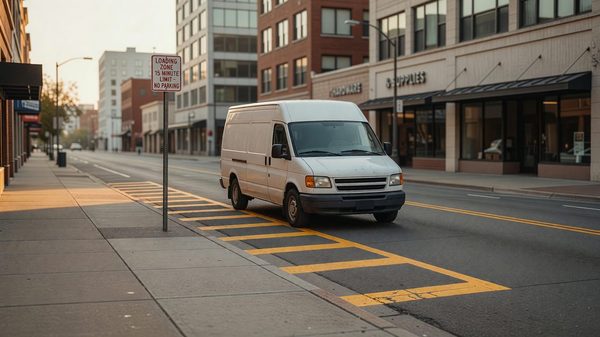
A single downtown block is a manageable thing to reinvent. A city can close a loading zone to unrestricted parking, repaint the curb, bolt on new signage, wire up a sensor or two, and watch what happens for a few months without disrupting much beyond that block. That’s exactly how most of the smart loading zone pilots that launched over the past two years got started — one corridor, a handful of curb segments, a vendor contract scoped small enough to get through procurement quickly.
The harder question, and the one a growing number of transportation departments are now sitting with, is what happens after the pilot works. Turning a single-block experiment into a citywide or even a five-neighborhood program means new budget lines, new enforcement workflows, new signage standards, and — often the trickiest part — a public conversation about who the curb is actually for, once it’s no longer a one-block novelty and starts affecting parking availability, small-business deliveries, and curb access across whole commercial districts. Pittsburgh’s experience over the past year is probably the most closely watched example of a city working through exactly that transition, and it offers a useful preview for every mid-sized city planning its own loading-zone pilot for 2023.
What Is a Smart Loading Zone, and How Is It Different From a Regular One?
A conventional loading zone is a static piece of curb regulation: a sign, a time window, sometimes a color of paint, and an assumption that enforcement staff will periodically check whether the vehicle parked there is actually loading or unloading rather than just parked. A “smart” or reservation-based loading zone adds a digital layer on top of that same physical curb space. Delivery and service drivers use a mobile app to check real-time availability, reserve a specific loading spot for a set window, and pay a variable rate tied to how long they intend to stay. The city, in turn, gets usage data — arrivals, departures, dwell time, how often the zone turns over — that a sign-and-paint loading zone never generates.
The pitch to cities is straightforward: a single loading zone that turns over efficiently can serve far more delivery vehicles per day than one where trucks double-park for twenty minutes because the marked zone is already occupied, or because there was no way to know it was occupied before driving over. The pitch to delivery fleets is similarly direct — a driver who can check availability before arriving, and reserve a spot instead of circling the block, spends less time hunting for curb space and more time on their route.
Pittsburgh’s Department of Mobility and Infrastructure launched its first Smart Loading Zone pilot downtown in spring 2022, working with curb-management vendor Automotus and the Pittsburgh Parking Authority. The pilot repainted a small number of curb segments purple — a deliberate, highly visible break from the green- and yellow-striped loading zones drivers were used to — and paired that paint with camera-based sensors that could detect vehicle arrivals and departures without requiring drivers to check in through an app at all.
From One Downtown Corridor to Five Neighborhoods
What makes Pittsburgh’s rollout worth watching a year later isn’t the initial pilot — plenty of cities have run a single-corridor loading-zone experiment — it’s what the city did next. Over the course of 2022, the purple-curb program expanded well beyond its original downtown footprint, adding zones in Oakland, Lawrenceville, the South Side Flats, and Bloomfield. By the end of the year, roughly twenty Smart Loading Zones were operating across those five neighborhoods, with downtown still accounting for the largest share of the total.
That expansion pattern is itself the finding. Rather than attempting to convert a large share of a neighborhood’s loading zones at once, Pittsburgh added a handful of segments to each new area, prioritizing the specific blocks with the most visible congestion — busy retail corridors and dense multi-unit residential blocks where competition between delivery trucks, ride-hail pickups, and passenger parking was already a known complaint. That is a meaningfully different scaling strategy than digitizing an entire loading-zone inventory in one pass, and it’s consistent with what curb-data practitioners have generally recommended: start with the corridor where the problem is worst and easiest to measure, not the corridor that’s administratively easiest to convert.
City staff have been candid that the program is still in a data-gathering phase rather than a victory-lap phase. Early usage patterns point in the direction planners hoped for — busier turnover and shorter average stays on the converted segments compared to the unrestricted parking that preceded them — but Pittsburgh has not yet published a full before-and-after evaluation, and officials have been careful not to oversell preliminary numbers before a more rigorous review is complete. That caution is worth noting for any city tempted to lean on a vendor’s early usage dashboard as proof of concept before running its own independent read of the data.
What Are Other Cities Doing With Reservation-Based Curb Space?
Pittsburgh isn’t alone, and it isn’t even first. Coord — the curb-management company backed by Sidewalk Labs — ran an earlier round of reservation-based “Smart Zone” pilots in Aspen, Omaha, Nashville, and West Palm Beach beginning in 2020, giving those four cities a multi-year track record to draw on. Aspen’s version is worth flagging for a detail Pittsburgh hasn’t attempted yet: the city applied the same reservation model to loading that happens in alleyways, not just curbside segments, converting eleven of its busiest loading locations — seven curbside, four in alleys — into managed Smart Zones. Aspen’s initial pilot ran for three months and was extended for four more, with the city adding roughly 45 percent more zones to the program based on what it learned.
Philadelphia and Santa Monica have also moved into smart-loading-zone territory using similar reservation and dynamic-pricing mechanics, and both are among the cities that have folded their pilots into the Open Mobility Foundation’s broader push to standardize curb data through the Curb Data Specification, which reached its 1.0 release in mid-2022. That connection matters for a practical reason: a city running a reservation-based loading zone is generating exactly the kind of granular arrival, departure, and dwell-time data that a standardized curb-data feed is built to carry. Cities that build their pilot’s data model around an open specification from the outset avoid having to retrofit that data into a shareable format later, when a second vendor, a regional planning agency, or a delivery platform wants to consume it.
Why Scaling a Pilot Is Harder Than Launching One
The operational lift of adding a fourth or fifth neighborhood to a smart loading zone program is not simply “more of the same, at scale.” A few frictions tend to show up specifically at the scaling stage that a single-corridor pilot never has to confront:
Enforcement consistency becomes a real constraint. A single downtown corridor can be watched closely by parking enforcement staff who already work that beat. Five neighborhoods spread across a city require either a much larger enforcement footprint or heavier reliance on the automated sensor data itself to flag violations — which raises its own questions about accuracy, appeals, and how a driver contests a citation generated by a camera rather than an officer.
Signage and paint standards need to be genuinely uniform. Pittsburgh’s purple curb is distinctive precisely because it doesn’t resemble any other curb color drivers already associate with parking, loading, or transit restrictions. That distinctiveness is an asset in a single pilot corridor; at citywide scale, a city has to make sure every driver — not just the ones who happened to encounter the pilot block — understands what purple paint means, which typically requires a public-education push well beyond a sign at the curb itself.
Small businesses and residents notice differently at scale. A one-block pilot can fly under the radar for most residents. A program that touches dozens of blocks across five commercial districts becomes something local business associations and neighborhood groups have opinions about — particularly if the loading zone in question sits in front of a storefront that used to have unrestricted customer parking, or if the pricing model makes casual use more expensive than infrequent users expect. Cities that treat this as a communications afterthought tend to find out about the friction from a city council inquiry rather than from their own outreach.
Who Pays for a Program That Outgrows Its Pilot Budget?
Most smart loading zone pilots start on grant funding, a discretionary capital line, or a vendor-subsidized proof-of-concept arrangement — none of which is designed to fund a permanent, citywide program. Scaling a pilot into an ongoing operation forces a city to answer a budgeting question that a single test block never requires: does the program pay for itself through the reservation fees drivers pay, does it need a recurring line in the transportation department’s operating budget, or does it require an ongoing state or federal grant relationship to stay solvent?
That question isn’t purely academic. Curb-management vendors typically price their hardware, software, and data services on a per-zone or per-segment basis, which means a program’s operating cost scales roughly linearly with the number of zones — while the usage-fee revenue a zone generates depends heavily on how much of the day it’s actually occupied by paying drivers versus sitting empty. A downtown corridor with heavy, consistent delivery traffic may come close to covering its own costs; a lower-traffic residential loading zone in an expansion neighborhood may not, at least not on its own. Cities weighing an expansion are increasingly modeling this zone-by-zone rather than assuming a program-wide average will hold.
What Should a Planner Watch Before Scaling Their Own Pilot?
For a city that ran a single-corridor loading zone pilot in 2022 and is now deciding whether to expand in 2023, a few questions are worth answering before committing budget to a multi-neighborhood rollout:
Do you actually have an independent read on your pilot’s performance, or only the vendor’s dashboard? A vendor’s usage metrics are a reasonable starting point, but a city’s own transportation planning staff should validate turnover and dwell-time claims against an independent sample before treating them as the basis for a scaling decision.
Have you identified which additional corridors have a documented curb-congestion problem, rather than simply the corridors that are easiest to convert? Pittsburgh’s neighborhood-by-neighborhood expansion tracked known problem areas rather than converting whatever inventory was administratively convenient — a distinction that matters both for program impact and for the public case a city can make when explaining why a given block was chosen.
Is your enforcement model built for a scale beyond your pilot? A plan that depends on the same handful of enforcement officers who covered the pilot corridor will not hold once the program covers five times the territory; cities need to decide early whether that means more enforcement staffing, more automated detection, or some blend of both.
Are you building your data around an open standard from the start? A city adopting a reservation-based loading zone system for the first time has a real opportunity to specify, in its vendor contract, that usage data be deliverable in a format compatible with the Curb Data Specification — avoiding a costly reformatting exercise later if the city adds a second vendor, joins a regional data-sharing effort, or wants a delivery platform to consume its curb data directly.
Frequently Asked Questions
What is a smart loading zone?
A smart loading zone is a curbside or alley segment managed through a mobile app and often sensor hardware, where delivery and service drivers reserve space in advance, pay a time-based rate, and the city collects data on arrivals, departures, and dwell time — replacing a conventional loading zone’s static signage-only enforcement model.
Which cities have expanded smart loading zones beyond an initial pilot?
Pittsburgh expanded its Automotus-run program from a single downtown corridor in spring 2022 to roughly twenty zones across five neighborhoods — downtown, Oakland, Lawrenceville, the South Side Flats, and Bloomfield — by the end of the year. Philadelphia and Santa Monica have pursued similar reservation-based models.
How is a smart loading zone different from the Curb Data Specification?
They operate at different layers. A smart loading zone is an operational program — the paint, sensors, app, and pricing that manage a physical curb segment. The Curb Data Specification is the data format some of those programs use to publish their regulations and activity in a standardized, vendor-neutral way so other systems can read it.
What’s the biggest obstacle to scaling a loading-zone pilot citywide?
Enforcement consistency is usually the first constraint cities hit. A single pilot corridor can rely on existing enforcement staff already covering that beat; a multi-neighborhood program requires either a larger enforcement footprint or heavier reliance on automated detection, which introduces its own accuracy and appeals questions.
Do smart loading zones generate enough revenue to fund themselves?
It varies by zone. High-traffic corridors with consistent delivery demand can come close to covering their operating costs through usage fees; lower-traffic zones in expansion neighborhoods often can’t on their own, which is why cities are increasingly modeling program economics zone by zone rather than assuming a single average will apply citywide.
Related Coverage
- Curb Data Specification 1.0 Is Here: What It Means for Commercial Loading Zone Management — the open curb-data standard that programs like Pittsburgh’s are increasingly aligning their reservation data to as they scale past a single pilot corridor.
- Federal ATCMTD Grants Just Added Parking Technology to the Eligibility List — one of the federal funding channels cities weighing a pilot-to-program jump for curb-management hardware and vendor contracts may be able to draw on.
The Institute of Transportation Engineers maintains a curbside-management resource library, including practitioner guides on allocating and regulating curb space, at ite.org. Pittsburgh’s Department of Mobility and Infrastructure publishes program details and public engagement materials for its Smart Loading Zones at engage.pittsburghpa.gov.