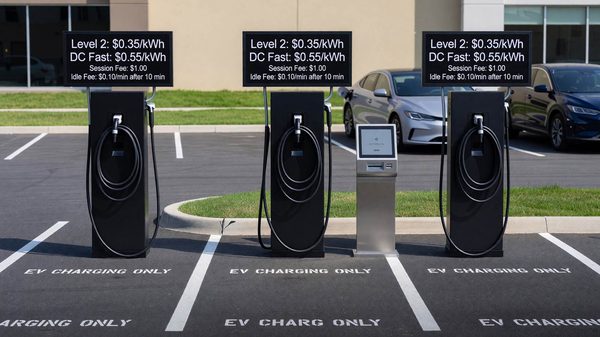
A parking space with an EV charger attached to it isn’t functioning like an ordinary parking space anymore — it’s a piece of shared energy infrastructure, and a growing number of municipalities are updating parking codes to reflect that distinction rather than treating charging bays as an afterthought bolted onto existing rules.
The core principle behind most of these updates is straightforward to state and more complex to enforce: you may occupy a designated EV charging space only while actively charging. Working through what that principle actually requires for signage, enforcement, and time limits is where the real policy complexity lives.
What “Active Charging” Means in Practice
A growing number of municipal parking codes now specify that a vehicle parked in a designated EV charging space must be actively connected and charging — not simply an electric vehicle parked in the general vicinity. Under this framework, an EV that occupies the bay without connecting, or that finishes charging and remains parked, is treated as a violation using the same enforcement logic that governs any other time-limit overstay.
A related and increasingly common provision addresses “ICE-ing” — the practice of a non-electric vehicle occupying a space designated for EV charging. Municipal codes that explicitly prohibit this, and that authorize towing rather than citation-only enforcement, are becoming more common, reflecting a view among some jurisdictions that blocking a charging bay is closer in severity to an accessible-parking violation than a routine meter infraction.
Cities vary in how they handle the specific mechanics — some rely on posted time limits in addition to the active-charging requirement, while others rely on the practical constraint that most charging sessions naturally self-limit dwell time. The details differ enough by jurisdiction that operators working across multiple markets should confirm each city’s specific code language rather than assuming a uniform national standard.
The Enforcement Gap
Writing the rule is the straightforward part. Enforcing an active-charging requirement presents challenges that traditional parking enforcement, built around static time-stamp checks, doesn’t handle cleanly.
Standard enforcement relies on marking a vehicle’s position at one point in time and returning later to check for continued presence past a limit. Active-charging violations don’t fit that model well: a vehicle may be present within its time limit but not actually connected, or it may have been connected and charging when an officer’s first pass came through and finished charging by the time of a second pass — meaning the same vehicle could read as compliant or non-compliant depending entirely on when it’s checked.
Cities are addressing this gap in a few different ways. Where charging infrastructure is city-owned and networked, some jurisdictions have built integrations so the charging network itself reports session start and stop times to the parking-enforcement system — the most precise option, but one that requires contractual and technical coordination between the transportation department and the charging-network operator. Where charging equipment is privately installed, that kind of integration is generally harder to arrange, and enforcement leans more heavily on manual visual checks for cord connection, which catches obvious ICE-ing violations but misses the “finished charging but still parked” pattern.
What Code Revisions Are Actually Changing
Beyond the core active-charging requirement, the broader wave of municipal code updates tends to touch several connected issues:
Signage standards. Updated codes increasingly specify what signage must accompany a designated EV bay — equipment type, enforcement hours, applicable time limits, and the ICE-exclusion rule. Standardized, unambiguous signage matters directly for voluntary driver compliance.
Towing authority for blocked bays. A number of updated ordinances now explicitly authorize towing, not just citation, for vehicles improperly occupying an EV charging space, reflecting the view that citation-only enforcement provides limited deterrence for drivers who rarely park in the affected area.
Time limits on charging duration itself. Some off-street facilities are introducing maximum charge-time limits distinct from general parking time limits, intended to prevent a vehicle from occupying a bay for hours after reaching a full charge — though enforcing this generally requires session-level data from the charging equipment, not just arrival-time observation.
Coordination with broader curb-data efforts. Cities that are separately building digital curb inventories are increasingly folding EV bay designations into that same data layer, so the bay’s designation is visible to navigation apps, fleet operators, and delivery platforms that route using curb data — rather than existing only as a physical sign and a line in the municipal code.
Building Codes Are Driving Charging Infrastructure at New Construction, Separately From the Curb
Alongside curb-specific ordinances, a number of state and local building codes have introduced EV-readiness requirements for new construction — generally specifying that some share of new parking spaces at commercial, hospitality, and multifamily residential developments must be wired to support EV charging, whether or not a charger is installed at the time of opening. Requirements and thresholds vary meaningfully by jurisdiction and building type, so any exact percentage or threshold should be confirmed against the specific state or local code in force rather than assumed to be uniform.
The curb is a separate and generally more complex regulatory environment than private new-construction parking, because public right-of-way charging infrastructure requires coordination between a transportation department and the local utility, in addition to standard permitting — a curbside charging station needs a conduit run to an electrical connection point, equipment standards for public-facing hardware, and an ongoing maintenance responsibility that falls to the city rather than a private property owner. Several cities have active curbside charging programs at varying scales, and the common friction point across them tends to be utility-coordination timelines for trench permits and conduit installation, which typically run longer than the equipment procurement itself.
Residential and Overnight Charging Adds Another Layer
A distinct policy challenge emerges in dense residential neighborhoods where many households have no access to off-street parking and therefore no practical way to charge at home. Curbside charging is often proposed as the answer, but the use pattern is very different from the daytime commercial-corridor case that most active-charging rules were written around. An overnight charging session at a residential curb can legitimately last many hours, which sits awkwardly against a general presumption that a charging bay should turn over quickly.
Municipalities working through this tend to split the difference by treating time-of-day differently — allowing longer dwell during overnight hours when demand for the space is lower, while keeping tighter turnover expectations during the day. Some also grapple with whether curbside chargers in residential areas should be tied to permit-holder access or remain fully public, a question that touches equity concerns as much as engineering ones. There is no settled national convention here, and the approaches in use vary widely enough that any operator or planner should look at how comparable neighborhoods in their own region have handled it rather than assume a dominant model exists.
What Parking Operators Should Track
For operators of public facilities — city garages, surface lots, and on-street programs — the practical questions raised by this code environment are operational rather than legal:
Does your facility’s charging equipment support session-data integration with your parking-management system, or is enforcement relying on manual visual checks alone? Vendors supplying networked charging equipment typically offer session-data APIs; the open question is usually whether the operator’s own systems are configured to receive and act on that data.
Is your local jurisdiction’s parking ordinance current enough to actually authorize enforcement — including towing, where applicable — once charging infrastructure is in place? A charging bay with clear signage but no enforceable ordinance behind it is, in practice, unprotected from ICE-ing regardless of what the sign says.
Industry guidance on curb management has consistently emphasized that curb allocation should reflect actual use patterns rather than administrative defaults. An EV bay chronically occupied by charged-but-not-moved vehicles or by ICE vehicles is effectively unavailable for its intended function, and no code revision fixes that without the enforcement infrastructure to back it up.
Frequently Asked Questions
What does “active charging” mean under a typical municipal EV parking code? It generally means a vehicle occupying a designated EV charging space must be physically connected to the charger, not merely an electric vehicle parked nearby. A vehicle that isn’t connected, or that has finished charging and remains parked, is typically treated as a violation.
Can a city tow a non-EV vehicle blocking a charging space? An increasing number of municipal ordinances explicitly authorize towing, not just citation, for this kind of violation — but authority varies by jurisdiction, so confirm the specific local code rather than assuming towing authority is universal.
Why is enforcing active-charging requirements harder than standard parking enforcement? Traditional enforcement relies on checking a vehicle’s presence at two points in time. Active-charging status can change between those two checks — a vehicle may finish charging and remain parked between an officer’s first and second pass — which standard time-stamp enforcement doesn’t reliably catch without session-level data from the charger itself.
Do all cities require a separate maximum charge-time limit beyond the active-charging rule? No — some rely solely on the active-charging requirement, while others add a specific time limit for off-street facilities. This varies by jurisdiction and generally requires charging-session data to enforce properly.
What should a fleet or delivery operator confirm before relying on curbside EV charging in a new city? Confirm whether the local jurisdiction’s curb data is current and integrated with navigation or routing platforms, since a charging bay that exists only as a physical sign and isn’t reflected in a city’s digital curb inventory may not be visible to routing systems that plan around curb data.
Further Reading from Authoritative Sources
- US Department of Energy — Alternative Fuels Data Center — federal tracking of state and local EV infrastructure policy, including parking and charging ordinances.
- ITE — Institute of Transportation Engineers — transportation engineering guidance relevant to parking facility design, including EV charging integration.
Related Reading
- The Digital Curb in Practice: What Cities Learn from Curb Twins
- NEVI’s State Plans Are Approved. Now the Bottleneck Is Parking-Lot Design. — the earlier NEVI parking-lot design debate that these municipal charging codes ultimately grew out of.