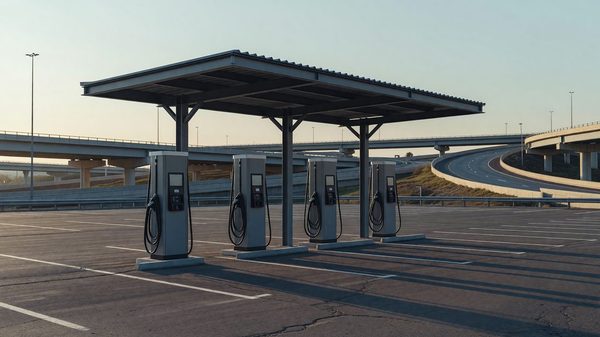
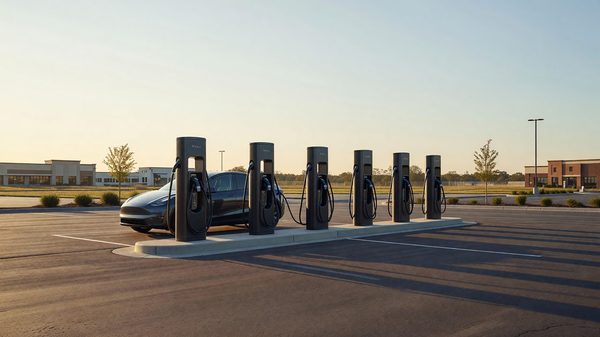
Ten months ago, a truck-stop operator or shopping-center owner weighing whether to bid into a state’s NEVI site-host solicitation was working from a proposed rule — a draft with a comment period still open and language that could plausibly shift before anything became binding. That changed on February 28, when the Federal Highway Administration published the final National Electric Vehicle Infrastructure Standards and Requirements rule in the Federal Register, and again on March 30, when the rule actually took effect. For the parking-lot owners and facilities managers who signed site-host agreements against the 2022 proposal, the last four weeks have been the moment those assumptions either held up or didn’t.
Most of the attention on the final rule so far has gone to the pieces that make headlines: the 150 kW-per-port power floor, the Buy America domestic-content fight, the four-port minimum. Those matter, but they were largely already locked in at the proposal stage last June and confirmed again when states’ plans were approved in September. What actually changed between the draft and the binding version, and what’s new for the party that owns the pavement rather than the charging equipment, is a narrower and less-covered story — and it’s the one that determines what a site host is actually signing up to operate for the next several years.
What the Final Rule Locks In That the Proposal Left Open
A proposed rule is, by definition, negotiable. FHWA’s June 2022 draft went through a formal comment period that closed August 22, and the agency received input from state DOTs, charging network operators, the U.S. Chamber of Commerce, and site-host trade groups before anything became enforceable. The version that took effect March 30 answers several questions the proposal left unresolved, and at least one of the answers landed differently than the draft language suggested it might.
The clearest example involves hours of public access. The proposed rule’s draft language pushed toward a blanket 24/7 public-availability requirement for any NEVI-funded charger. Commercial-vehicle interests, including the Chamber, argued that Congress’s own statutory language in the Bipartisan Infrastructure Law allowed NEVI-funded stations to restrict access to authorized commercial fleet operators in some contexts, and that a rigid round-the-clock public-access rule didn’t match how corridor charging would actually be used by trucking and fleet customers. The final rule split the difference in a way that matters directly to a site host’s own operating hours: chargers located along a state’s designated Alternative Fuel Corridor must be available 24 hours a day, seven days a week, year-round, full stop. Chargers funded under NEVI but sited off those corridors only need to be accessible as often as the site host’s own business hours run. A shopping-center lot that closes at 10 p.m. and reopens at 8 a.m. can build an off-corridor NEVI station on that same schedule; a travel center on a designated corridor cannot, regardless of when its convenience store is staffed.
That distinction is easy to miss when reading press coverage of the rule, but it’s the difference between a site host needing to staff, light, and secure a parking lot overnight indefinitely, or not. For any facility owner still finalizing a NEVI site-host agreement, confirming which category a given parcel falls into — corridor or off-corridor — is now a contract term with real operating-cost consequences, not a formality.
The 97% Uptime Requirement a Site Host Doesn’t Fully Control
The final rule requires each charging port funded under NEVI to maintain an average annual uptime of at least 97%, with defined exclusions for scheduled maintenance, vandalism, and force-majeure events like natural disasters. On paper, uptime is a charging-network-operator metric — it measures whether the hardware and software are online and dispensing power at the required minimum rate. In practice, a meaningful share of what drives downtime at a real site sits on the property side of the fence rather than the charger side: a damaged electrical service run, a blocked stall that prevents a technician’s service vehicle from reaching a cabinet, snow removal that buries a charging bay before a plow route gets to it, or a site host’s own construction project that cuts power to a section of the lot.
States, as the direct recipients of NEVI formula funds, are the parties formally accountable to FHWA for uptime compliance across their funded network, and they’re expected to build uptime obligations into their site-host and operator agreements to make that accountability enforceable downstream. A parking facility that hosts a NEVI charger is not the reporting party to FHWA, but it is very likely to be a party to a state or network-operator contract that assigns it responsibility for site conditions that affect uptime — snow and ice clearance around charging bays on a defined schedule, keeping charging stalls unobstructed by non-charging vehicles, and providing timely access for service calls. Site hosts negotiating or renegotiating agreements this spring should expect uptime-adjacent maintenance obligations to show up as contract line items now that the underlying federal requirement is no longer hypothetical.
Payment Rules That Reach Into How the Lot Operates
The final rule sets payment requirements that read like consumer-protection provisions but that a parking-lot operator will feel operationally. Every NEVI-funded charger must accept contactless payment via major credit and debit cards, offer a toll-free phone or SMS-based payment option as an alternative, and cannot require a membership or app account to complete a basic charging transaction. Pricing must be displayed in dollars per kilowatt-hour before a session starts and cannot change mid-session, and any additional fees — including, notably, parking or idle fees layered on top of the electricity charge — have to be disclosed as part of that upfront pricing display rather than assessed after the fact.
That last point is the one that intersects most directly with parking operations. A number of site hosts, including several with existing non-NEVI charging installations, have used idle fees or time-based parking charges as the mechanism for discouraging a car from occupying a fast-charging stall after it finishes charging — exactly the throughput problem this publication has covered as fast charging displaces conventional gas-station-style turnover assumptions. Under the final rule’s pricing-transparency requirements, any such fee at a NEVI-funded station has to be disclosed to the driver before they plug in, not introduced as a surprise line item on the receipt. Site hosts building idle-fee or overstay-fee structures into their NEVI stations need those fees baked into the point-of-sale display and rate schedule from the start, not layered on afterward as an operational workaround.
The Buy America Waiver: A Site Host’s Timing Problem, Not Just a Manufacturer’s
Buy America requirements attach to federally funded infrastructure by default, and EV charging hardware — much of which has historically been assembled from globally sourced components — was not close to meeting a strict domestic-content bar when the final rule took effect. Rather than let that mismatch stall the entire program, FHWA issued a temporary waiver on February 21, a week before the final rule’s own publication, that phases in domestic-content compliance in two steps. Through June 30, 2024, the waiver largely suspends domestic-content requirements for NEVI-funded chargers except for the charger housing’s steel and iron content. Starting July 1, 2024, chargers must meet a 55% domestic-content cost threshold across their components, with the housing subject to separate, stricter domestic steel-and-iron sourcing rules.
For a site host, this isn’t simply a manufacturer’s supply-chain problem to watch from a distance. It’s a procurement-timing question: equipment ordered and installed before mid-2024 has meaningfully more sourcing flexibility, and potentially more competitive lead times and pricing, than equipment procured after the compliance threshold tightens. A parking facility owner sequencing site construction against a state’s broader corridor buildout has a real incentive to understand where its own installation falls relative to that July 2024 line, since it affects which charging-hardware vendors can realistically bid on the job and at what cost.
The Accessibility Question the Final Rule Still Didn’t Answer
Readers who followed this program through last September’s state-plan approvals will recall that FHWA’s minimum standards, even at that stage, didn’t specify binding accessible-design dimensions for EV charging stalls — that gap was filled only by the U.S. Access Board’s July 2022 technical guidance document, which described a roughly 132-by-240-inch accessible charging space with a full-length 60-inch access aisle, but explicitly as non-binding recommendations rather than an enforceable standard.
The final rule that took effect March 30 does not close that gap. It requires NEVI-funded stations to comply with the accessibility standards already in place under existing DOT and DOJ ADA regulations — general parking accessibility rules adopted years before EV charging existed as a use case — without adding a charging-specific binding standard of its own. The Access Board’s own formal rulemaking process to write charging-specific accessibility guidelines into the ADA and ABA Accessibility Guidelines is a separate, ongoing effort that has not concluded. Until it does, the July 2022 recommendations remain the most current authoritative reference for what an accessible charging stall should look like, but a site plan built only to generic ADA parking-space dimensions, without the wider vehicle space and full-length access aisle a charging cable actually requires, would not violate anything in the NEVI final rule as written.
That’s a real design risk hiding in plain sight. A parking facility that builds its NEVI-funded accessible stalls to minimum literal compliance rather than to the Access Board’s fuller recommendation may pass a NEVI compliance review today and still need a costly retrofit whenever the Access Board’s separate rulemaking eventually lands. Facilities staff who haven’t already adopted the July 2022 dimensions as their internal design baseline, as this publication suggested last fall, now have direct confirmation that the final rule isn’t going to make that decision for them.
What Should Parking and Facilities Staff Do With This?
A few concrete actions are worth taking in the weeks immediately following the rule’s effective date, while site-host agreements for this year’s construction season are still being negotiated or finalized:
Confirm in writing whether each planned or existing NEVI charging location sits on a designated Alternative Fuel Corridor or off it, since that single fact determines whether 24/7 public access is mandatory or whether the site host’s own posted hours govern. This should be a line item in the site-host agreement, not an assumption.
Review draft or existing site-host contracts for uptime-related maintenance obligations — snow and ice clearance commitments, stall-obstruction prevention, and service-access provisions — and make sure whoever manages day-to-day facility operations, not just whoever negotiated the deal, understands what they’re now accountable for.
If idle fees, overstay fees, or any other parking-specific charge is planned for a NEVI-funded stall, build the disclosure of that fee into the point-of-sale pricing display from day one rather than treating it as a separate parking-management decision layered on afterward.
Sequence procurement timing, where there’s any flexibility in the construction schedule, against the July 1, 2024 Buy America compliance threshold, since hardware sourcing options and lead times are likely to tighten after that date.
Treat the Access Board’s July 2022 accessible-design recommendations as the actual design floor for any NEVI-funded accessible stall, regardless of what the final rule’s own accessibility language technically requires, to avoid a retrofit once separate ADA rulemaking for EV charging concludes.
Frequently Asked Questions
When did the NEVI final rule take effect, and how is that different from when it was published?
FHWA published the final rule in the Federal Register on February 28, 2023. Under standard federal rulemaking procedure, it became legally effective 30 days later, on March 30, 2023. The gap between publication and effective date is a routine implementation window, not a sign of ongoing negotiation.
Does the final rule require 24/7 public access at every NEVI-funded charging station?
Only for stations located on a state’s designated Alternative Fuel Corridor, which must be available 24 hours a day, seven days a week, year-round. Stations funded under NEVI but sited off those corridors only need to be accessible as often as the site host’s own business hours, a distinction that affects staffing and security planning.
Who is responsible for hitting the 97% uptime requirement — the charging network operator or the parking facility that hosts the equipment?
States are formally accountable to FHWA for uptime across their NEVI-funded network and typically pass enforceable uptime obligations down through contracts with charging operators and site hosts. A parking facility owner is unlikely to be the direct reporting party but should expect maintenance-related uptime obligations — snow clearance, stall access, service-vehicle access — in its own site-host agreement.
Did the final rule adopt binding accessible-design dimensions for EV charging stalls?
No. The final rule requires compliance with existing general ADA parking accessibility regulations but does not add a charging-specific binding standard. The U.S. Access Board’s July 2022 recommendations for wider charging spaces and full-length access aisles remain non-binding guidance pending a separate, still-open rulemaking process.
How does the Buy America waiver affect a parking facility’s charger procurement timeline?
A February 21, 2023 waiver suspends most domestic-content requirements for NEVI-funded chargers through June 30, 2024, aside from steel and iron in the charger housing. Starting July 1, 2024, chargers must meet a 55% domestic-content cost threshold. Equipment ordered before that date has more sourcing flexibility and potentially better pricing and lead times.
Related Coverage
- The NEVI Formula Program’s Proposed Standards: What They Mean for Parking Facility Operators — the June 2022 proposed-rule stage that the final rule covered in this article ultimately superseded.
- NEVI’s State Plans Are Approved. Now the Bottleneck Is Parking-Lot Design. — the September 2022 milestone that first flagged the accessible-stall design gap this article confirms remains open under the final rule.
Further Reading from Authoritative Sources
- Federal Register — National Electric Vehicle Infrastructure Standards and Requirements — the full final rule text as published February 28, 2023.
- U.S. DOE Alternative Fuels Data Center — NEVI Standards and Requirements Final Rule — plain-language summary of the final rule’s core requirements maintained by the Department of Energy.
- FHWA — National Electric Vehicle Infrastructure (NEVI) Formula Program — program overview and state plan resources maintained by the Federal Highway Administration.