For the better part of this year, the National Electric Vehicle Infrastructure (NEVI) Formula Program has been a paperwork story: proposed standards, a submission deadline, a comment period. That changed on September 14, when the Federal Highway Administration announced it had approved EV Infrastructure Deployment Plans for more than two-thirds of states, the District of Columbia, and Puerto Rico — ahead of the 60-day review window FHWA had set for itself — unlocking upwards of $900 million in combined fiscal year 2022 and 2023 NEVI formula funding. Additional state approvals are expected to follow this month as FHWA works through the remaining plans.
For the parking and facilities planners who have been watching NEVI from the sidelines, the shift in urgency is real. Money that was theoretical in June is now apportioned and available for states to obligate. The question is no longer whether NEVI charging stations are coming to interstate corridors — it’s where, exactly, they will sit, how they will be sized, and how the parking spaces around them will need to be designed, striped, and managed differently than a conventional lot. That last set of questions is where a lot of the practical work is about to concentrate.
What the Approved Plans Actually Commit States To
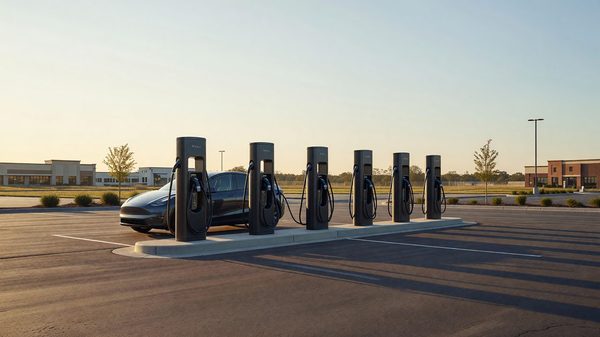
Each approved EV Infrastructure Deployment Plan is a state’s roadmap for spending its NEVI apportionment against the program’s minimum standards, which FHWA proposed in a Notice of Proposed Rulemaking published in the Federal Register on June 22 and which remain technically open for finalization even as states plan against them. The core siting rule hasn’t changed since the proposal stage: states must build out publicly accessible DC fast charging along their designated Alternative Fuel Corridors until that network is certified “fully built out,” defined as a charging site roughly every 50 miles and within one mile of an interstate interchange, with each site required to host at least four DC fast chargers using the Combined Charging System connector, each capable of delivering 150 kW simultaneously to four vehicles at once.
That is a meaningfully larger physical footprint than a typical highway-adjacent charging installation has needed to be until now. Four simultaneous 150 kW ports means substantial electrical service upgrades in many locations, and it means a minimum of four dedicated charging stalls — plus the maneuvering and queuing space around them — has to fit somewhere near an interchange that, in a lot of corridor segments, doesn’t currently have a paved lot sized for it. States’ approved plans identify corridor priority segments and funding sequencing, but the actual site-level work — finding a parcel, negotiating a site-host agreement, laying out the stalls — happens after plan approval, not as part of it.
Why Parking-Lot Design Is Suddenly the Critical Path
Ask a state DOT NEVI program manager what’s keeping them up at night this month and the answer is rarely the electrical engineering. It’s site availability and layout. NEVI funding flows to charging equipment and installation costs, but it doesn’t relocate a gas station, expand a travel plaza’s parking footprint, or resolve a stormwater or setback issue on a parcel that looked adequate on a map and turns out to be too shallow once a site plan is drawn.
Most states are pursuing NEVI buildout by soliciting private site hosts — existing travel centers, truck stops, convenience stores, and retail parking lots along the corridor — rather than building state-owned charging plazas from scratch. That approach is faster and avoids the state taking on long-term operational responsibility for the equipment, but it means the actual parking-lot design work falls to whichever private operator wins a given corridor segment, working against a federal minimum-standards checklist that most commercial site plans weren’t drawn to meet. A four-port, 150 kW DCFC bank generally needs more dedicated square footage, more electrical capacity, and a different traffic flow pattern than the two-port, lower-power Level 2 or DCFC installations many retail hosts have already built for their own marketing purposes — which means some existing “EV-ready” sites will need to expand or reconfigure rather than simply add a NEVI-branded sign to what’s already there.
There’s also a parking-management dimension that’s easy to overlook next to the engineering questions. DC fast charging is fundamentally a turnover-oriented use — a typical session runs 20 to 40 minutes for a meaningful charge, not the multi-hour dwell time associated with overnight Level 2 charging at a workplace or multifamily lot. A charging stall sitting occupied by a vehicle that finished charging an hour ago functions, in practice, exactly like a blocked parking space, and it defeats the throughput the federal minimum standards are trying to guarantee along a corridor. Site hosts and the states overseeing them are going to need enforcement or pricing mechanisms — idle fees, time limits, or dynamic signage — that most conventional parking lots have never needed for a card-swipe gas pump or a set of vending machines.
What Changed This Summer on Accessible Charging Stalls
One gap that’s been narrowing in real time: accessible design guidance specific to EV charging. As of earlier this summer, NEVI’s own minimum standards didn’t spell out EV-charging-specific accessibility dimensions, leaving general ADA parking requirements — written decades before DC fast charging existed — as the operative floor. On July 21, the U.S. Access Board issued Design Recommendations for Accessible Electric Vehicle Charging Stations, a technical assistance document that lays out how existing ADA, ABA, and Section 508 standards apply to charging infrastructure and fills in the areas those standards don’t address directly.
The Access Board’s recommendations describe an accessible EV charging space with a minimum width of roughly 132 inches (11 feet) and a minimum length of roughly 240 inches (20 feet), paired with an adjacent access aisle at least 60 inches (5 feet) wide running the full length of the charging space — dimensions driven by the reality that a charging cable, its handle, and the equipment pedestal all have to be reachable from a wheelchair without crossing a vehicle travel lane. Those are recommendations rather than a binding rule for the moment, since the Access Board’s own rulemaking process to formally amend its accessibility guidelines for EV charging is still ahead of it. But state DOTs and private site hosts writing site-design specifications for NEVI-funded stations now have a concrete reference point to design against, rather than extrapolating from parking-stall guidance that predates the technology.
For parking facility planners, the practical takeaway is that an accessible charging stall isn’t simply a standard accessible parking space with a charger bolted beside it. The combination of a wider vehicle space, a full-length access aisle, and equipment placement that keeps the cable within reach without a doorway obstruction is a distinct design problem, and it needs to be treated as one from the first site layout sketch rather than retrofitted after paving is complete.
Who Actually Decides Where the Chargers Go?
Plan approval answers a corridor-level question — which highway segments a state will prioritize and roughly how much funding is sequenced toward each. It doesn’t answer the parcel-level question of which specific interchange, which side of the highway, or which existing commercial lot ends up hosting the equipment. That decision typically runs through a state’s own procurement process: a competitive solicitation, sometimes structured as a reverse auction on a per-port basis, through which private site hosts bid to build and operate NEVI-compliant stations on their own property in exchange for a share of construction cost reimbursement.
That structure puts real influence in the hands of commercial real estate decisions that predate NEVI by years — where a truck stop chain already owns land, where a convenience-store operator has expansion capital available, where a parcel’s existing electrical service can be upgraded without a lengthy utility interconnection queue. Local governments generally aren’t the ones selecting NEVI corridor sites, but they aren’t bystanders either: a winning site host still has to clear whatever local site-plan review, parking-ratio, stormwater, and zoning approval process applies to a commercial parking-lot expansion in that jurisdiction, and a state’s aggressive buildout timeline can run headlong into a municipal permitting queue that wasn’t built with a federal deadline in mind.
Transportation and planning officials at the municipal level who want a voice in where corridor charging lands within their jurisdiction have the most leverage early — flagging permitting timelines, parking-code conflicts, or preferred parcels to their state DOT’s NEVI program office before a solicitation closes, rather than after a site host has already been selected and is submitting for local permits.
What Should Planning and Facilities Staff Do Before the Next Construction Season?
A few practical steps are worth taking now, while most states are still in the early stages of standing up their site-host solicitation processes:
Review local zoning and parking codes specifically for how they treat DC fast-charging stalls — required stall dimensions, accessible-space ratios, and whether existing parking-ratio credit rules recognize charging infrastructure the way they recognize, say, bicycle parking or transit access. A code written before 2020 likely has no language addressing this at all, which can slow down a site plan more than an outright prohibition would.
Identify commercially owned parcels within a mile of interstate interchanges in the jurisdiction that plausibly could host a four-port DCFC bank, and understand who owns them, before a state solicitation forces a fast decision. Municipalities that have already mapped these parcels are better positioned to weigh in on site selection.
Treat the Access Board’s July recommendations as the design baseline for any locally reviewed EV charging site plan, even though they aren’t yet a binding federal rule — adopting them now avoids a costly retrofit if and when they become mandatory.
Start a conversation with public works or parking enforcement staff about how turnover will be managed at any future DCFC installation on a municipal lot, since fast-charging dwell patterns don’t match the assumptions built into most existing parking-enforcement software and signage.
Frequently Asked Questions
What did FHWA actually approve on September 14?
FHWA approved EV Infrastructure Deployment Plans — the roadmap document each state submits describing how it will spend its NEVI apportionment — for more than two-thirds of states plus the District of Columbia and Puerto Rico, ahead of its self-imposed 60-day review window. Approval unlocks access to that state’s NEVI formula funding.
Does an approved state plan mean charging stations are being built right now?
Not yet in most places. Plan approval unlocks funding and confirms a state’s corridor priorities; it doesn’t by itself select the specific parcels or complete the site-host solicitation process that determines exactly where a charging station will be built or when construction starts.
Why do NEVI stations need four charging ports instead of two?
FHWA’s proposed minimum standards require at least four DC fast-charging ports per site, each capable of 150 kW simultaneously, to ensure adequate throughput along designated highway corridors. That’s a larger footprint and electrical load than many existing commercial charging installations were built to support.
Are accessible EV charging stalls required under current rules?
NEVI’s own minimum standards don’t yet mandate specific accessible-design dimensions. The U.S. Access Board’s July 2022 design recommendations fill that gap with technical guidance — a wider vehicle space and a full-length access aisle — that isn’t yet a binding rule but is the most current authoritative reference available.
Who chooses the exact site for a NEVI-funded charging station?
Most states run a competitive solicitation process in which private site hosts — travel centers, truck stops, retail lots — bid to build and operate compliant stations on their own property. Local governments generally don’t select sites directly but retain permitting and zoning authority over any winning proposal.
Related Coverage
- The NEVI Formula Program’s Proposed Standards: What They Mean for Parking Facility Operators — the proposed-rule stage of this same program, for planners tracking how the standards evolved into approved state plans.
- Federal ATCMTD Grants Just Added Parking Technology to the Eligibility List — a second, non-NEVI federal funding lane that some corridor-adjacent parking facilities may be able to pursue in parallel.
Further Reading from Authoritative Sources
- FHWA — National Electric Vehicle Infrastructure (NEVI) Formula Program — program overview, minimum standards, and state plan resources maintained by the Federal Highway Administration.
- U.S. Access Board — Design Recommendations for Accessible Electric Vehicle Charging Stations — technical guidance on accessible EV charging space and access aisle dimensions.
- NACTO — Curb Management — broader guidance on multi-function curb and parking-adjacent infrastructure planning.