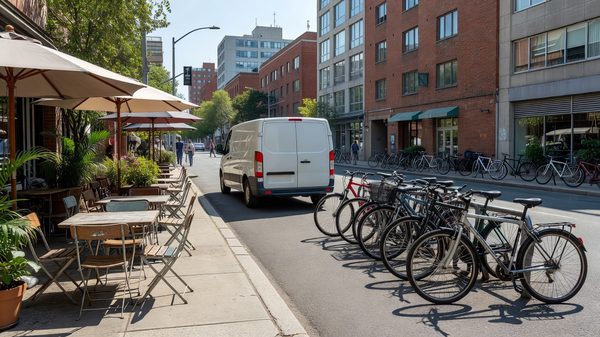
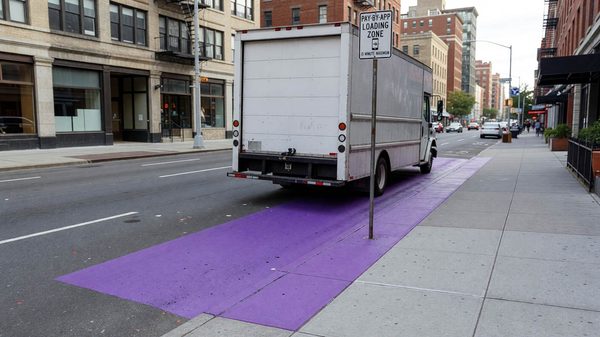
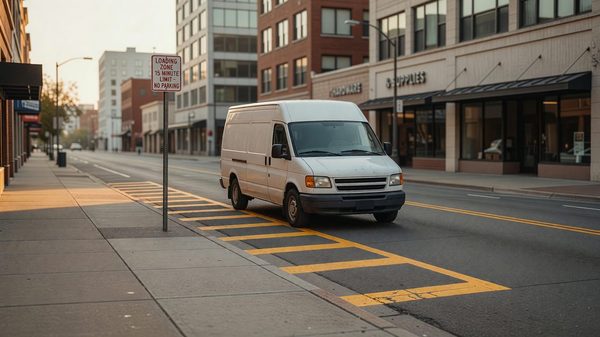
Houston’s Smart Loading Zone pilot puts camera sensors and license plate recognition on commercial loading zones in downtown and midtown, automatically identifying vehicles and billing registered accounts for time at the curb. The zones are marked with purple-painted curbs and enforced Monday through Saturday, with hours varying by location — typically 7 a.m. to 6 p.m., though some run 7 a.m. to 4 p.m., 9 a.m. to 6 p.m., or 9 a.m. to 4 p.m. No enforcement on Sundays or city-observed holidays. The vendor is Automotus.
The technology is not the interesting part. Plate recognition at the curb is well established. What a mid-size city should study is the pricing structure, the registration model, and the enforcement fallback, because those are the decisions that determine whether a program like this works — and they are decisions any city makes regardless of vendor.
The rate structure is a turnover instrument
Houston’s pricing escalates by dwell duration rather than charging a flat per-minute rate:
| Duration | Rate | Cumulative max |
|---|---|---|
| 0–10 minutes | $0.06/min | $0.60 |
| 11–20 minutes | $0.12/min | $1.80 |
| 21–30 minutes | $0.15/min | $3.30 |
| 31–60 minutes | $0.19/min | $9.00 |
The per-minute rate roughly triples between the first ten minutes and the last half hour. A ten-minute delivery costs sixty cents; an hour costs nine dollars — fifteen times as much for six times the time.
This is a deliberate design, and it targets the actual failure mode of a loading zone. Loading zones do not fail because they are priced wrong on average. They fail because a small number of long-dwell vehicles occupy them, forcing everyone else to double-park in the travel lane. A flat rate treats a 5-minute stop and a 50-minute stop as proportionally equivalent. An escalating rate makes the long stop disproportionately expensive, which is where the congestion cost actually sits.
The magnitudes are also worth noting for their modesty. Sixty cents for a short delivery is low enough that it does not meaningfully change the economics of making the delivery — the mechanism works through the tail of the distribution, not by taxing routine use. Cities that set the entry rate high enough to be a real cost on short stops tend to push commercial vehicles back into the travel lane, which is the outcome the program exists to prevent.
Removing the transaction is the substantive change
The registration model matters more than the sensors. Drivers register at a vendor portal or by scanning a QR code at the zone signage; recognised vehicles are billed automatically, with no permit, no pay station, and no app interaction at the curb.
This addresses a compliance problem that curb-management programs consistently underestimate. A delivery driver making forty stops has no realistic ability to complete a payment transaction at each one, and a system that requires it produces systematic non-compliance that is not really willful. Removing the transaction means compliance becomes the default state for any registered vehicle rather than something the driver must actively achieve forty times a day.
For a planner, the consequence is that the program’s data quality depends on registration penetration, not on enforcement intensity. A high-registration, low-enforcement program produces a clean dataset of who used which curb for how long. A low-registration program produces an invoice pipeline and a lot of disputes.
The fallback defines the risk
Unregistered vehicles receive mailed invoices, with escalating administrative fees of $10, then $15, then $25 if unpaid.
This is the part of the design a city should scrutinise hardest, because it is where an efficiency program can quietly become a collections program. The nine-dollar maximum for a full hour is a usage charge. A $25 administrative fee on an unpaid invoice is something else, and it attaches to the least sophisticated users — occasional users, out-of-town vehicles, drivers who never saw the signage.
The ratio is the thing to watch. If administrative fees become a material share of program revenue, the program is no longer pricing curb access; it is monetising unfamiliarity. A city adopting this model should instrument that ratio from day one and set a threshold at which the registration and signage approach gets revisited rather than the fee schedule.
The privacy posture, and its limits
Houston’s stated position is that license plate data is collected for payment processing, that plate information is the only form of personally identifiable information collected, and that the system additionally retains de-identified traffic metadata and sample images for algorithm training.
That is a reasonably tight scope as written, and it is more specific than many municipal LPR deployments disclose. Two things are worth a city’s attention when adapting it.
First, “sample images for algorithm training” is a real carve-out. Images of a public curb will contain pedestrians, storefronts, and vehicles not party to any transaction. A city should know the retention period, who holds the images, and whether a vendor’s training corpus survives the contract.
Second, plate data is highly re-identifiable, and its sensitivity comes from aggregation across time rather than from any single read. A retention limit is the control that matters most, and it should be in the contract rather than in the FAQ.
What a mid-size city should take from it
The transferable lessons are structural. Price by escalating dwell rather than flat rate, because the problem is long occupancy rather than average occupancy. Remove the per-stop transaction, because compliance that requires forty deliberate acts per shift will not happen. Treat registration penetration as the primary success metric during a pilot, ahead of revenue. Instrument the administrative-fee share and decide in advance what level would indicate the program has drifted.
The pilot is described as running 18 months, which is long enough to produce a real before-and-after on curb turnover and double-parking. The number worth waiting for is not revenue — it is whether the share of deliveries occurring from the travel lane went down on the treated blocks. That is the outcome the program is actually for, and it is the one that would justify the capital cost in a city without Houston’s downtown density.